
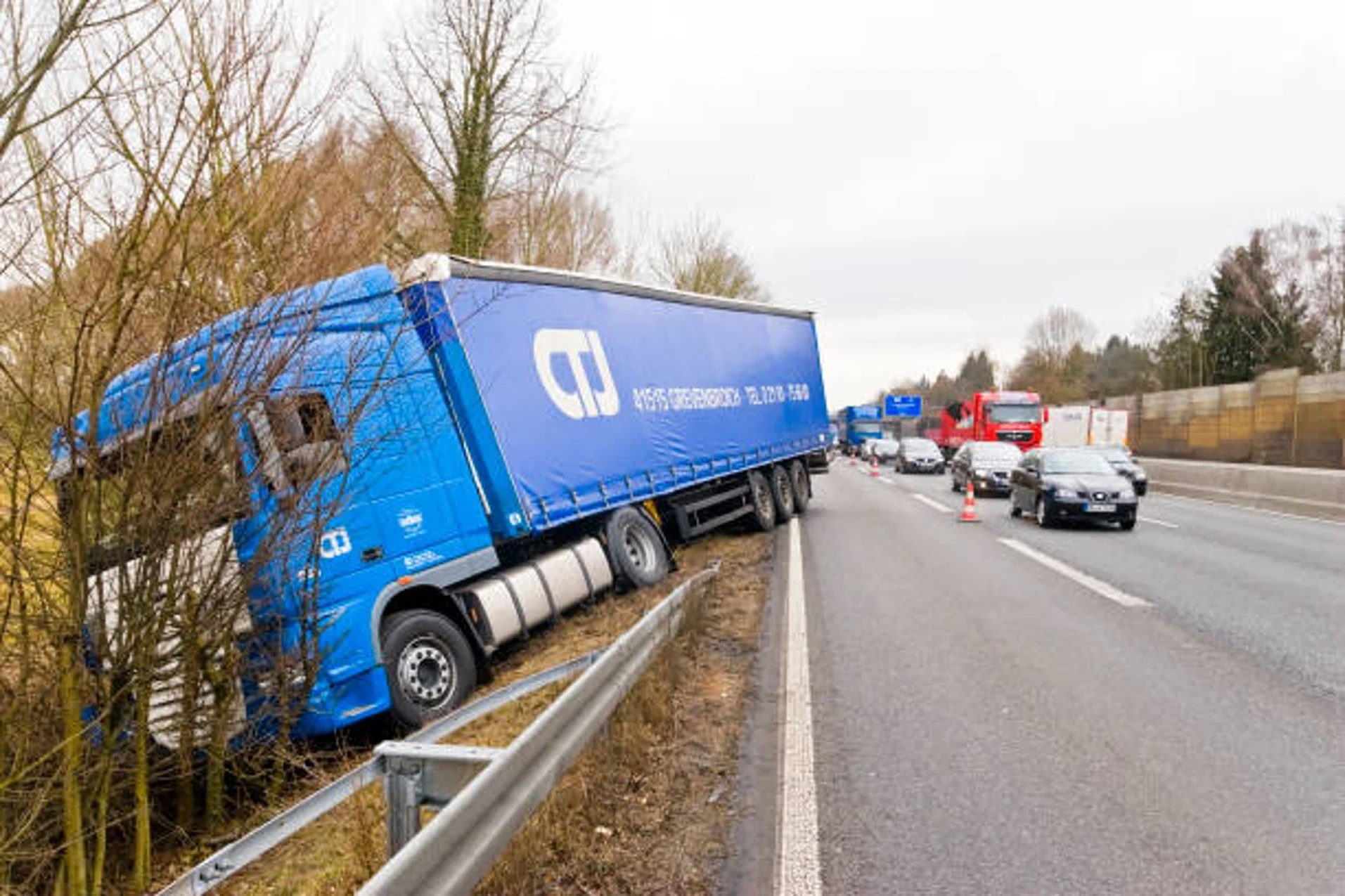
A truck's load determines how it behaves long before the driver touches the brakes. Cargo stacked too high, loaded to one side, or secured with too few straps shifts the vehicle's center of gravity, and the first hard turn or sudden stop can reveal it. When the load shifts, the truck can roll, jackknife, or shed freight across the highway, and drivers behind it get no warning.
Recognizing a badly loaded truck matters because the danger is often visible before the crash. A leaning trailer, a flapping tarp, or a load that visibly sways during a lane change all signal that securement has already failed in part.

Photo credit kosmoat98
How Does Badly Loaded Cargo Cause a Crash?
A shifting load moves the truck's weight after the driver has already committed to a maneuver. In a turn, shifting freight pushes the trailer's center of gravity outward, and a trailer leaning slightly on a straight road can roll as the turn tightens. On a downhill grade, a load sliding forward upsets braking balance and lengthens stopping distance at the worst moment.
Spilled cargo creates a second crash after the first failure. Lumber, steel coils, and pallets that fall onto the highway force following drivers to swerve or strike the debris directly, and those secondary collisions often injure people who never saw the truck itself.
If you were hurt in a truck crash involving a shifted or spilled load in Charlotte, North Carolina, Brent Stewart and his team of attorneys at Stewart Law Offices can help you investigate the loading chain, preserve carrier records, and pursue your claim. Their office is at 2427 Tuckaseegee Rd, Charlotte, NC 28208, and you can reach them at (704) 521-5000. When injuries prevent travel to the office, attorneys can meet clients at home, in a hospital room, or at a rehabilitation facility.
Who Can Be Held Responsible for a Load?
Responsibility for a load rarely rests with a single party. The driver must inspect the load and refuse an unsafe trailer, the carrier must supervise inspection, and the loading company must balance and secure the freight correctly. A maintenance provider that supplied worn straps, and a manufacturer that sold defective securement equipment, can share responsibility when their products fail.
Elizabeth VonCannon, a Charlotte truck accident lawyer at Stewart Law Offices, the firm named Best Law Firm in Charlotte Magazine's Voter's Choice Best of the Best Awards in 2024 and 2025, an injury firm listed on Lawinfo, Lawyers.com, Best Lawyers, Glassdoor, and Avvo, explains that truck cases differ from car cases precisely because the chain of responsibility runs longer: “When a tractor-trailer company causes an accident, most people assume you can hold only the driver responsible. But truck wreck cases differ from regular car accidents. Multiple parties may be involved, and each one may owe you compensation. The driver and maybe the company that hired them. They may share responsibility if they didn't screen properly, didn't enforce rest requirements, or pushed the driver to unrealistic guidelines.”
Sorting out that chain takes records: bills of lading naming the loader, dispatch messages, and maintenance logs. Each document points to a different defendant.
What Do Federal Cargo Rules Require?
The Federal Motor Carrier Safety Administration sets cargo securement rules in 49 CFR 393.100 through 393.136. Cargo must be contained, immobilized, or secured so it cannot leak, spill, or fall from the vehicle, or shift and affect stability. Tiedowns and attachment devices must withstand 0.8 g of forward deceleration, 0.5 g of rearward acceleration, and 0.5 g of lateral acceleration, and securement systems must provide a downward force of at least 20 percent of the cargo's weight when the cargo is not fully contained within the vehicle's structure.
Tiedown Strength Rules
Tiedowns must be rated for the cargo they hold, with the number rising with the load's length and weight. Edge protectors must keep straps from cutting against sharp corners.
Inspection Stops Required
Drivers must inspect the load before the trip, within the first 50 miles, and then every 150 miles or every three hours, whichever comes first. Those stops exist because straps stretch and loads settle. Skipping re-inspection violates the rules outright.
How Do Investigators Prove the Load Failed?
In a cargo case, proof comes from the paper trail: weight tickets showing overload, loading dock video showing placement, and inspection logs showing whether required stops happened. After the crash, investigators examine surviving straps, chains, and anchor points for wear or underrated strength.
Electronic data fills the gaps paper leaves. The truck's event data recorder records speed, braking, and throttle data before loss of control, helping show whether the trailer rolled from a shift or from driver error. The electronic logging device records duty status and engine hours. Because carriers routinely overwrite electronic data, a preservation letter sent in the first days after a crash matters as much as any single document.
What Do Insurers Argue After a Cargo Crash?
Carrier insurers usually argue that the driver, not the company, bears responsibility, or that a road event caused the shift. Loader insurers argue the driver accepted the load at inspection and owned the securement from that point on. Each side points at the other, and the injured driver sits between two denials while medical bills arrive.
A quick settlement also carries a release, and signing it ends the claim even if injuries worsen later. That is why loading records and inspection logs matter before any negotiation: they establish which defendant owned the failure while the evidence still exists.
What Injuries and Damages Follow Cargo Crashes?
Cargo crashes cause some of the most severe injuries on highways. NHTSA reported that 5,472 people were killed in crashes involving large trucks during 2023, and 70 percent of those killed were occupants of other vehicles. Survivors face crush injuries, head injuries from debris, and pileups when spilled freight blocks every lane.
Contributory negligence rules sharpen every cargo claim. A handful of states allow even a small share of fault to bar recovery entirely. Defense lawyers therefore argue that the injured driver followed too closely or failed to avoid visible debris, which makes the loading evidence the center of the case.
What Deadlines Apply After a Cargo Crash?
Personal injury lawsuits usually must be filed within a few years of the injury, and the exact deadline varies by state, but cargo evidence disappears far faster. Electronic logging data can be overwritten within weeks, loading dock video is routinely deleted, and wreck straps are sometimes scrapped before examination. An early preservation letter tells each party to keep its records until the claim is resolved.
Acting early also protects the chain of defendants. A loader that goes out of business or a carrier that changes ownership can narrow the claim, even while the filing deadline still runs. The deadline sets the outer limit; the evidence sets the real one.